
Junior Mining Companies in Canada
Canada hosts roughly half the world’s publicly listed mining and mineral exploration companies. Most of them are juniors – small-cap, exploration-focused entities that don’t produce anything yet. The TSX Venture Exchange alone listed 47.5 billion shares traded in 2025, up 44.6% from the year before, and the 2026 TSXV Venture 50 had 48 mining companies on it with average share-price gains of 443% over the year. The sector is volatile, capital-hungry, and fundamentally different from the major mining companies most people picture when they think “mining stocks.”
This page covers what a junior mining company actually is, how the sector is financed, where the listings live, what the risks are, and what changed in 2025-2026. It is not a stock recommendation. Junior mining is high-risk and not appropriate for all investors.
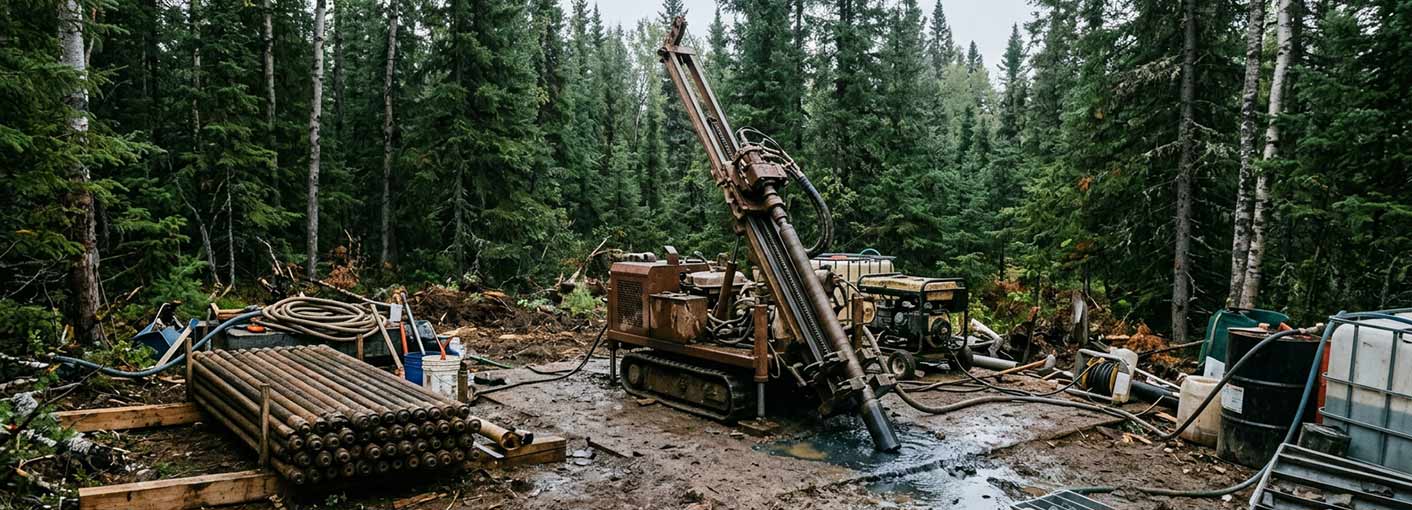
What separates a junior from a major
The line is fuzzy but real. Major producers – Newmont, Barrick, Agnico Eagle, Rio Tinto, Glencore – operate multiple mines, generate cash flow, pay dividends, and trade on senior exchanges. Their market caps are in the tens of billions. Their geological risk is largely behind them; their concerns are commodity prices, operating costs and ESG.
Juniors are pre-revenue. They raise money to drill holes. Most never find anything economic. The Crux Investor analysis cited in 2025 industry coverage put the odds at roughly 1 in 1,000 anomalies becoming a mine – meaning 999 juniors that drill never produce a pound of metal. Of those that do find something, many sell out to majors before reaching production rather than trying to build a mine themselves.

| Tier | Stage | Typical market cap | Revenue |
|---|---|---|---|
| Major | Multi-mine producer | $10B – $80B+ | Yes – billions |
| Mid-tier | Single producing mine or two | $1B – $10B | Yes – hundreds of millions |
| Developer | Has economic study, building or financing | $200M – $1B | Pre-revenue |
| Resource-stage junior | Defined NI 43-101 resource | $50M – $300M | Pre-revenue |
| Exploration junior | Early drilling, no resource yet | $5M – $50M | Pre-revenue |
How juniors are financed
Juniors don’t borrow against cash flow because they don’t have any. They sell equity. The dominant financing tool in Canada is the flow-through share – a tax structure that lets exploration companies pass deductions for eligible exploration expenses through to investors, who can use them against their own income. Flow-through shares provided about 75% of junior exploration capital in 2024, averaging $2.2 million per issuer.
Layered on top is the Mineral Exploration Tax Credit (METC) – a 15% federal credit on grass-roots Canadian exploration, raised to 30% for projects targeting critical minerals. The combination means an investor’s effective cost on a flow-through share can be reduced by 40% or more after credits, depending on province.
| Financing tool | How it works | Who uses it |
|---|---|---|
| Flow-through shares | Issuer renounces exploration deductions; investor uses them on personal tax | Most TSXV and CSE juniors |
| METC (federal) | 15% credit on grass-roots exploration; 30% for critical minerals through 2027 | All exploration-stage juniors |
| Hard dollar private placement | Standard share issuance; no tax structure attached | Larger juniors and developers |
| Bought deal | Underwriter commits to buying entire offering; common for resource-stage names | Mid-cap developers |
| Strategic investor | Major or royalty company takes equity stake, often with right of first refusal | Promising juniors with discoveries |
| Royalty / streaming | Royalty company funds exploration in exchange for future revenue percentage | Developers approaching production |
Equity dilution is the price of this model. The 2025 industry analysis from Crux Investor noted that a successful junior’s share count routinely balloons from 30-40 million at IPO to 500+ million by the time it reaches production – meaning early shareholders typically end up with a single-digit percentage of what they originally bought.
Where they list
Canadian juniors list mainly on two exchanges. The TSX Venture Exchange (TSXV) is the senior of the two – most resource-stage and developer-stage names live there, with stricter listing requirements. The Canadian Securities Exchange (CSE) is the more permissive option; it hosts smaller, earlier-stage companies and has lower ongoing compliance costs. There’s overlap, but the rule of thumb is: TSXV for companies with NI 43-101 resources or substantial drill data, CSE for prospect-generators and very early-stage explorers.
Companies often graduate from CSE to TSXV as they advance, then from TSXV to TSX as they reach production. A handful go straight to TSX through dual listings or RTO transactions. U.S.-listed counterparts live on the OTC markets – typically OTCQB for resource-stage names and OTCQX for senior juniors.
Risk – the unflattering version
The honest description: juniors are speculative. Most fail. Among those that survive, dilution destroys most of the upside. The 2025 EY mining risks list ranked capital access at the top, with policy uncertainty close behind – 79% of Fraser Institute survey respondents cited permitting delays as a major barrier.
“Junior mining stocks – unlike many of the best mining stocks – are highly speculative, and are apt to cost you money. Another reason why junior mines are risky is that it’s relatively cheap and easy to launch a penny mine and sell stock to the public.”
– Pat McKeough, The Successful Investor (March 2026)
Specific risks worth understanding:
- Permitting timelines. PDAC notes Canadian mine permitting averages 10-15 years from discovery to production – three to five times longer than Australia.
- Geological risk. Most projects fail to define an economic resource. Even those that do face metallurgical surprises, hydrology issues, and grade discontinuities.
- Funding risk. Juniors live or die on the next equity raise. A 12-18 month cash runway is the standard analyst threshold; less than that is a red flag.
- Promotion risk. Cheap to launch, easier to promote. The sector attracts more than its share of stock promoters whose interests aren’t aligned with shareholders.
- Commodity price risk. A 30% drop in gold or copper prices can render a marginal project uneconomic overnight.
What changed in 2025-2026
The sector ran hot in 2025. Gold trading at US$3,000+ for much of the year and US$4,150 in Q4 2025 dragged the entire junior gold sub-sector higher. Copper hitting record highs above US$10,000 per tonne pulled copper-focused juniors along. Lithium and rare earth juniors had a more uneven year – lithium prices fell in 2025 after the 2022-2023 spike, while rare earth juniors moved on policy headlines (the Defense Production Act stake in MP Materials, China’s 2023 export controls on REE separation tech).
Specific 2025-2026 sector developments:
- San Lorenzo Gold (TSXV) finished 2025 as the year’s top-performing TSXV gold stock, gaining over 1,000% from C$0.08 on Cerro Blanco discoveries in Chile.
- West Red Lake Gold (TSXV: WRLG) crossed from developer to producer at Madsen on January 1, 2026 – one of very few new gold mines starting up that year.
- Equinox Gold and Calibre Mining merged in February 2025 to create what will become Canada’s second-largest gold producer.
- Hemlo Mining Corp. (TSXV: HMMC, formerly Carcetti Capital) acquired Barrick’s Hemlo mine for up to US$1.1 billion, demonstrating that mid-tier gold M&A was alive and well.
- Sterling Metals’ (TSXV: SAG) high-grade copper hits at the Soo Copper Project north of Sault Ste. Marie triggered a multi-junior staking rush in October 2025.
- Olive Resource Capital reported 151% returns on its 2025 portfolio, signalling that experienced specialist investors had a strong year. Most retail investors did not match that.
How to read a junior’s technical disclosure
Every Canadian junior must publish a NI 43-101 Technical Report when it first files for an exchange listing or makes a material technical disclosure. The report has to be authored by a Qualified Person (QP) – typically a P.Geo. or P.Eng. with at least five years of relevant experience – and filed on SEDAR+. A few signals to look for in any technical report:
- Resource categories: Measured > Indicated > Inferred. Inferred resources cannot be used in feasibility studies. A project with 90% Inferred resources is much earlier-stage than one with 70% Measured + Indicated.
- Cut-off grade: Lower cut-off grades inflate resource numbers but reduce the proportion that can actually be economically mined. Compare cut-off grades across peer projects.
- Recovery rate: Metallurgical test work matters. A 95% gold recovery is great; 60% means you’re losing 40% of the value to waste.
- Capex and operating cost estimates: Compare against peer mines. Inflated capex projections kill projects when the bid time comes.
- QP independence: Independent QPs are required for new resource estimates. “In-house QP” reports get less weight from analysts.
Where the sector goes from here
Two structural forces are reshaping junior mining in Canada. The first is the critical minerals push – federal funding, the 30% METC for critical-mineral projects, and the Defence Production Act designation are all pulling capital toward copper, nickel, lithium, graphite, rare earths and uranium juniors at the expense of pure-play gold names. The second is permitting reform. Ontario’s One Project, One Process model and federal proposals to streamline impact assessment are real if slow-moving. The next mine permitted under those frameworks will tell the market whether the reforms have teeth.
The third force, less talked about: consolidation. Major producers sold off non-core assets in 2025 (Newmont divested $4.3 billion worth) and the buyers were mostly mid-tier and emerging companies. That asset rotation creates new mid-cap producers from former juniors and recycles capital into the next generation of exploration.
Notable Canadian-listed mining names
The list of Canadian-listed mining companies is too long for a single reference page, but a few names recur in 2025-2026 sector coverage often enough to warrant short context. None of the descriptions below are recommendations – they’re fact summaries from public filings.
| Company | Tier | Focus |
|---|---|---|
| Ivanhoe Mines | Senior producer | Copper-focused; major DRC operations + Western Foreland (Zambia) |
| Hudbay Minerals | Mid-tier | Copper-zinc producer; Manitoba Flin Flon belt + Peru Constancia |
| Pan American Silver | Senior producer | Silver and gold across Latin America |
| NexGen Energy | Developer | Rook I uranium project, Saskatchewan |
| Denison Mines | Developer | Wheeler River uranium, Saskatchewan |
| Talon Metals | Developer | Tamarack nickel-copper project, Minnesota |
| Ivanhoe Electric | Developer | U.S. copper-gold-silver portfolio |
| South32 | Senior producer | Diversified base metals |
| Glencore | Senior producer | Diversified; Sudbury nickel operations |
| Sayona Mining | Developer | Quebec lithium projects |
| Atkinsrealis | Engineering services | Mining EPCM contracts |
| Epiroc | Equipment supplier | Underground drilling, automation |
| Pangea (Montreal) | Service provider | Mining geology consultancy |
Beyond these, financial-side names matter for the sector economics: Eric Sprott has been an active investor in Canadian junior gold and silver names for decades; Burford Capital finances mining-related litigation. The junior mining network itself (juniorminingnetwork.com) is the standard daily news source for TSXV/CSE-listed names.
Specific junior mining angles get fuller treatment elsewhere on this site – past-producing gold mines coming back online, the rare earth metals build-out in Saskatchewan and the NWT, and Ontario’s Ring of Fire critical minerals district. SEDAR+ at sedarplus.ca is the authoritative source for all Canadian public company filings.
CSE mining companies – short note
The Canadian Securities Exchange (CSE) hosts a smaller share of Canadian mining listings than the TSXV but remains relevant for early-stage juniors with lower capitalization. CSE mining companies typically file the same NI 43-101 disclosures as TSXV peers but face less stringent quarterly continuous-disclosure requirements, which makes the listing route attractive for prospect generators and pre-resource explorers. Investors looking at investing in gold stocks Canada through the CSE should focus on the same fundamentals that apply to TSXV names: management track record, project quality, runway and dilution history.
Gold mining investments – formats
Beyond direct equity, several investment formats give exposure to Canadian gold mining: physical bullion and certificates, gold streaming and royalty companies (Franco-Nevada, Wheaton Precious Metals, Sandstorm Gold), passive index ETFs (the GDX VanEck Gold Miners ETF and GDXJ junior counterpart), and a smaller universe of mining sector ETFs covering broader resources. Each has a different risk profile: streaming companies’ trade at premium multiples but absorb development risk; junior gold ETFs swing harder than majors; sector ETFs dilute single-stock exposure but also dilute the leverage that draws investors to mining.
This domain was previously operated by Advance United Holdings Inc., later rebranded as Advanced Gold Exploration Inc. — a junior issuer focused on acquiring undervalued Ontario past-producing gold properties. As of 2026, Advanced Gold Exploration Inc. has migrated to a different domain. The site you are reading now is unaffiliated with the prior issuer and operates as an independent reference resource on the Canadian mining sector.